


China Accelerates Gold Purchases as Major Asset Managers Increase Exposure

The image is for illustrative purposes and was generated using artificial intelligence.
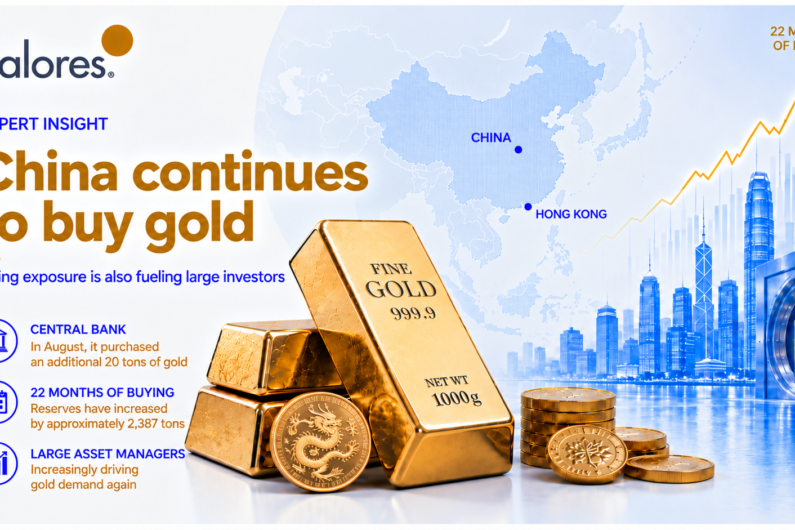
China’s central bank purchased an additional 20 tonnes of gold in August, extending its buying streak to 22 consecutive months. Following the recent price correction, some of the world’s largest asset managers are also increasing their gold positions again, while physical gold flows are increasingly shifting towards Asia.
The latest data point to several important shifts in the global gold market. China’s central bank continues to increase its gold reserves, some major asset managers are once again raising their exposure to gold, and Hong Kong is becoming an increasingly important hub for Russian gold. Preferences among Chinese buyers are also changing, with demand shifting away from jewellery and increasingly towards gold bars and coins.
China’s Central Bank Purchased Another 20 Tonnes of Gold in August
China’s central bank purchased an additional 20 tonnes of gold in August, extending its buying streak to 22 consecutive months. It also added 20 tonnes in July and 15 tonnes in June.
Since the beginning of the year, the People’s Bank of China (PBoC) has increased its official gold reserves by approximately 80 tonnes, placing it among the largest central-bank buyers of gold. China’s total reserves are estimated to have reached a record level of approximately 2,387 tonnes.
The pace of purchases has accelerated again in recent months despite high gold prices.
Major Asset Managers Are Also Increasing Their Gold Exposure
Following the price correction, some of the world’s largest asset managers have also begun increasing their gold positions again.
These include Amundi, Europe’s largest asset manager, while funds managed by Pictet Asset Management, Robeco and Fidelity International have also increased their purchases.
Amundi expects the gold price to return towards 5,000 USD per ounce by the end of the year. Major institutional investors largely view the recent decline as an opportunity to re-enter the market, as they believe the long-term factors supporting gold remain unchanged.
Russian Gold Is Increasingly Shifting Towards Asia
Changes are also evident in physical gold flows. In the first seven months of 2026, Hong Kong imported approximately 14.4 billion USD worth of gold from Russia, already around 50% more than in the whole of 2025.
Following Western sanctions, flows have shifted significantly away from traditional Western markets towards Asia, with Hong Kong becoming an increasingly important hub for Russian gold.
Chinese Buyers Are Shifting from Jewellery to Bars and Coins
Changes are also becoming apparent among Chinese consumers. Sales of gold jewellery are declining, many jewellery stores are closing outlets, and interest is increasingly shifting towards gold bars and coins.
High gold prices, fewer weddings and weaker consumer spending are putting pressure on the traditional jewellery segment, while investment gold is gaining importance. This shift suggests that Chinese buyers increasingly view gold as a form of savings and wealth protection, rather than solely as a luxury good.
China Is Also Reducing Its Exposure to US Treasuries
China has been gradually reducing its holdings of US Treasury securities for several years. At the same time, it has steadily increased its gold reserves, pointing to a broader diversification process away from US debt and the US dollar.
A projection based on a continuation of the current pace of selling indicates that China’s holdings of US Treasury securities could decline significantly further by the beginning of the next decade.
Multiple Shifts Across Different Parts of the Gold Market
China’s central bank has extended its gold-buying streak to 22 consecutive months, some major asset managers are once again increasing their positions, Hong Kong is recording strong growth in imports of Russian gold, and Chinese consumers are increasingly turning towards gold bars and coins.
These developments therefore span different parts of the market—from central banks and institutional investors to international physical gold flows and private buyers.
Sources: World Gold Council / Global Markets Investor; Bloomberg (4 September 2026); Financial Times / Hong Kong Census and Statistics Department; South China Morning Post; U.S. Treasury.
For those looking to include gold in their savings, the Valores Metal Account provides a simple way to buy gold and gradually build their holdings over time.
About The Author

Read also
China Accelerates Gold Purchases as Major Asset Managers Increase Exposure
China’s central bank purchased another 20 tonnes of gold in August, extending its buying streak to 22 consecutive months. At…

Notice of Temporary Unavailability of the Valores Metal Account App
We would like to inform you that due to urgent technical and software upgrades, access to the Valores Metal Account…
The World Is Accumulating Gold Again: Reserves Outside the US Reach Their Highest Level in Nearly Five Decades
Global gold reserves outside the US have reached their highest level in nearly five decades. Central banks are increasing gold’s…

How to Enable Two-Factor Authentication (2FA)
Quick and easy instructions for setting up two-factor authentication (2FA) to add extra protection to your account.
