


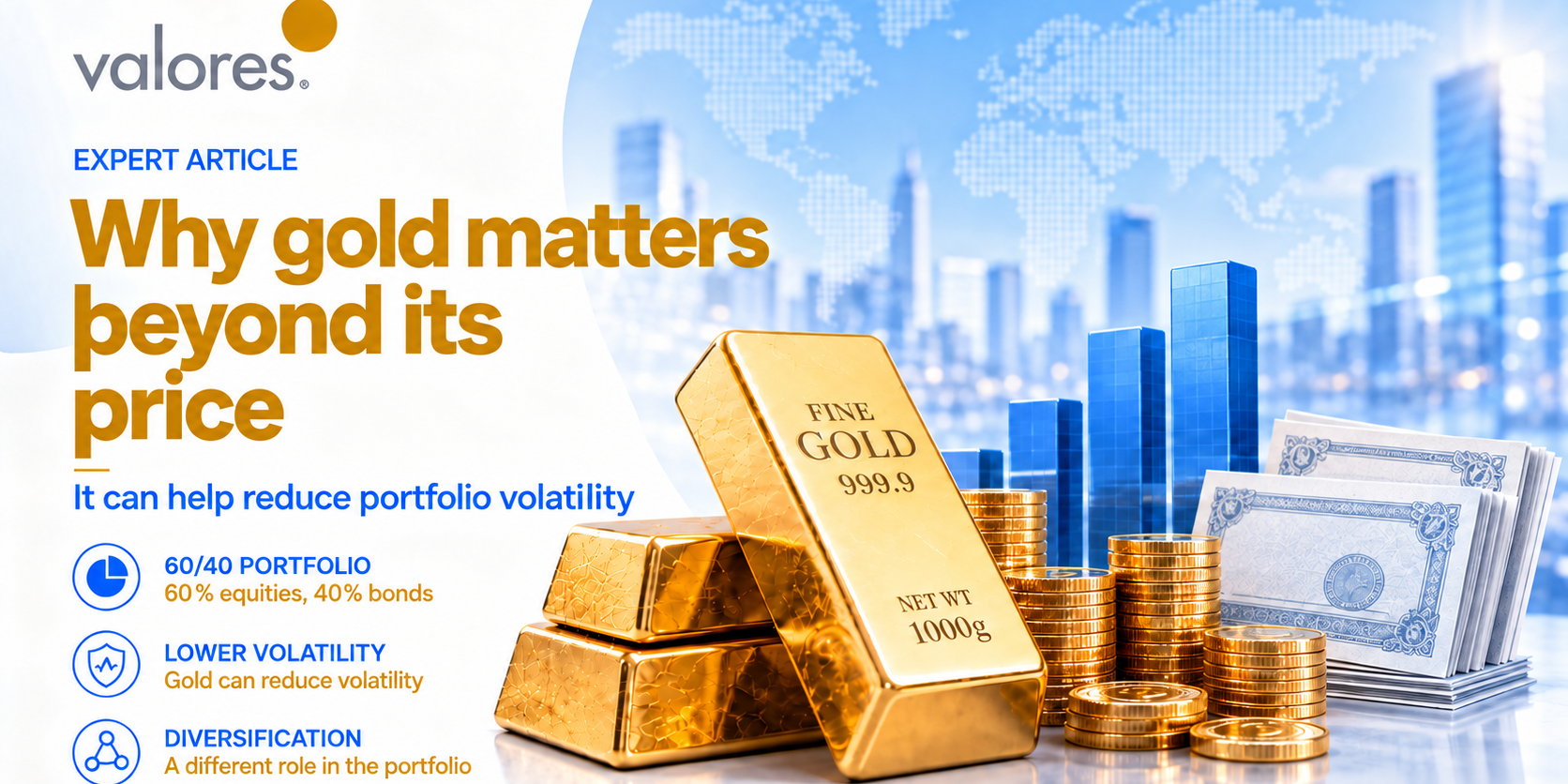
Gold in an Investment Portfolio: Why Does It Matter?
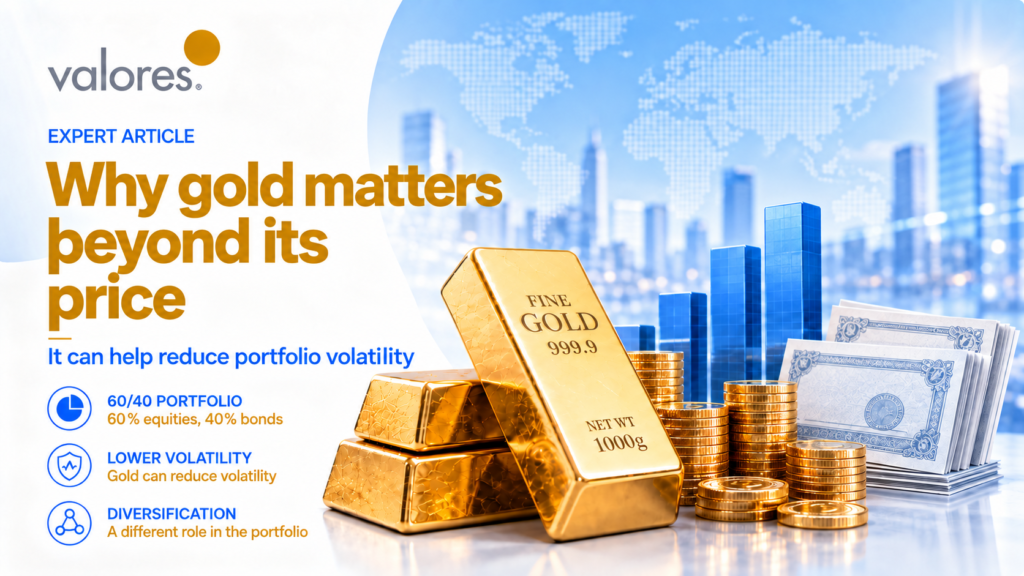
The image is for illustrative purposes and was generated using artificial intelligence.
Gold is not only relevant because of changes in its price. An analysis by Goldman Sachs shows that adding gold to a traditional portfolio of stocks and bonds can reduce fluctuations in the portfolio’s overall value. During certain historical periods, this effect was even more pronounced when gold was combined with energy commodities.
When building an investment portfolio, it is important to consider not only how much an individual investment might gain, but also how different assets respond to changes in financial markets.
The traditional approach is based on a combination of stocks and bonds. However, during periods when these two asset classes no longer provide the same degree of diversification as they once did, an important question arises: can other types of assets help spread investment risk?
What is a traditional 60/40 portfolio?
A 60/40 portfolio is a traditional investment allocation consisting of 60% stocks and 40% bonds.
The underlying idea is to combine two different asset classes. However, this allocation does not guarantee that stocks and bonds will move differently under all market conditions.
This is what makes Goldman Sachs’ analysis particularly relevant: it examines how the volatility of such a portfolio changes when gold is included.
Goldman Sachs: Gold can reduce portfolio volatility
An analysis by Goldman Sachs shows that, across several historical periods examined, a traditional stock-and-bond portfolio experienced lower volatility when gold was included.
In most of the periods presented, adding gold reduced portfolio volatility. In some periods, the effect was even more pronounced when exposure to energy commodities was included alongside gold.
This highlights an important aspect of portfolio diversification: gold can serve a different purpose from stocks or bonds. The objective is not necessarily to achieve the highest return from an individual investment, but also to manage fluctuations in the value of the overall portfolio.
Why does diversification still matter today?
The International Monetary Fund (IMF) has also highlighted the growing vulnerability of financial markets.
In a speech titled Navigating the Crosscurrents of a Changing World Economy, delivered on 7 October 2026, the IMF highlighted three important factors: high levels of public debt, energy-related pressures and an exceptionally strong investment cycle in artificial intelligence.
Together, these factors can make it more difficult to bring inflation down, keep borrowing costs elevated and increase financial market sensitivity.
The IMF also warns that global public debt is expected to approach or exceed 100% of global GDP, reducing governments’ ability to respond to future economic shocks.
In such an environment, understanding different sources of risk and diversifying investments becomes particularly important.
Gold as part of long-term wealth management
Goldman Sachs’ findings offer an additional perspective on gold, which is often assessed primarily in terms of its price, inflation or currency risks.
The analysis suggests that gold can also play a diversification role, particularly during periods when stocks and bonds no longer provide the same degree of protection against each other’s fluctuations.
This does not mean that adding gold will always reduce portfolio volatility or prevent losses. It does, however, suggest that evaluating gold’s role should involve looking at its impact on the entire investment portfolio, rather than focusing solely on changes in the gold price.
Sources: Goldman Sachs; International Monetary Fund (IMF); Kristalina Georgieva: Navigating the Crosscurrents of a Changing World Economy, 7 October 2026.
For those looking to include gold in their savings, the Valores Metal Account provides a simple way to buy gold and gradually build their holdings over time.
About The Author

Read also
Gold ETFs Reach Record Highs as Investors Increase Gold Exposure
Global holdings of physically backed gold ETFs have reached a record 4,250 tonnes, with investors allocating funds to gold ETFs…
Central Banks Increase Gold’s Role: No G7 Countries Among the Largest Buyers
None of the ten largest gold buyers since 2022 are G7 countries. At the same time, gold’s share of central…
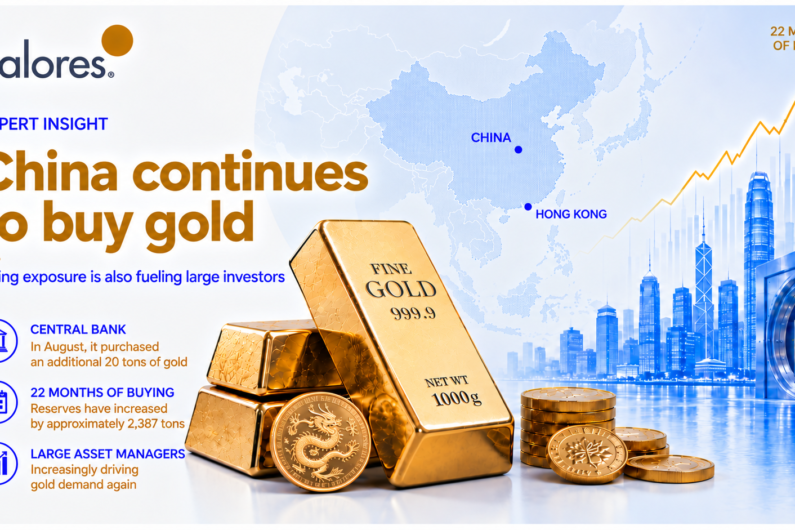
China Accelerates Gold Purchases as Major Asset Managers Increase Exposure
China’s central bank purchased another 20 tonnes of gold in August, extending its buying streak to 22 consecutive months. At…

Notice of Temporary Unavailability of the Valores Metal Account App
We would like to inform you that due to urgent technical and software upgrades, access to the Valores Metal Account…
